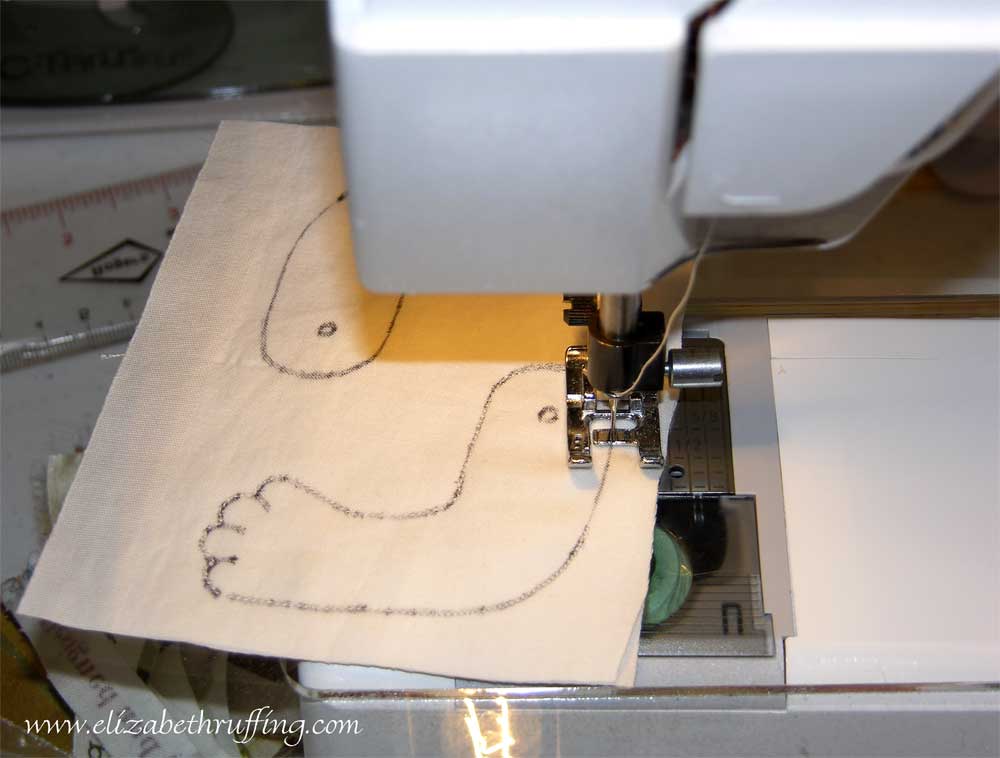
 I’ve been drafting patterns for a couple of new art doll designs and I’ve got two kittens and a bunny on the way. I thought a little behind-the-scenes look might be of interest for anyone interested in making painted cloth dolls. After I draft my patterns, I trace them onto cotton sheeting by taping my drawn patterns to a light box, and then laying my fabric over the patterns. You can achieve the same thing by taping a pattern to a window during the daylight hours, and then taping a piece of fabric over the pattern.
I’m using kind of fancy sheets, 300 thread count, Egyptian cotton sateen. I like them because they are soft and easy to hand stitch through, and the texture is very smooth. I’ve been getting mine at Linens and Things, but they may have discontinued the exact ones I’ve been using. Hopefully they have something similar. They usually have swatches you can feel. Look for soft and smooth. I wait for sales, but you can get so many dolls out of one full flat sheet, that it is well worth the price anyway. I prewash them, put them in the dryer, and then iron them. I use a permanent black Sharpie pen to draw my stitching lines, minus the seam allowances, on my fabric.
For each doll part, like for one arm, I trace the shape only once. Then I flip my fabric, wrong sides together, and pin. There is no need to line up any sewing lines this way. You do have to watch your grain lines however. It is important that the doll parts are aligned with the straight of grain as much as possible or distortion occurs while stuffing. I sew right on top of my sewing line, which is still visible even from the wrong side, through both layers of fabric. I use a small stitch length, about 1.5 to 2mm. I sew slowly to make sure I stay on my lines.
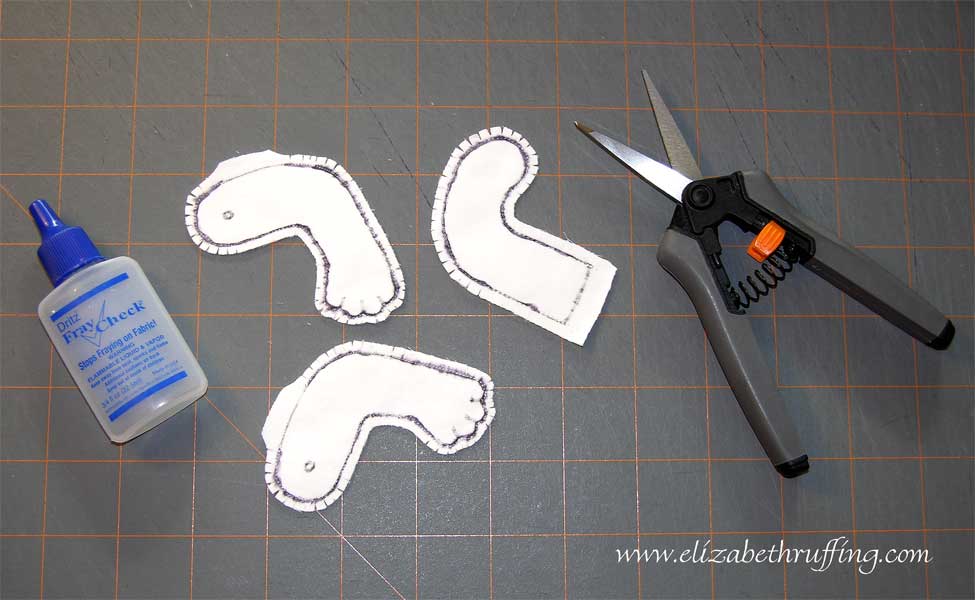 I trim my doll parts, leaving between 1/8 and 1/4 inches of fabric around the outside edge of each shape. I leave a little extra where the openings I left for turning the parts right side out are. I cut closer where there are little ins and outs, like where there are fingers. (You can click my pictures to get a larger view.) I clip my curves, taking little wedge shapes out of the convex curves and just straight clips out of the concave curves, up to about two threads width of my stitching line. Wherever there is a sharp angle in my stitching line, I cut to the point, as closely as possible without cutting my sewing line. A good sharp small pair of scissors is necessary, along with caution. I then use Fray Check within my seam allowance (along the outside edge of my sewing lines) to seal the clips I have made.
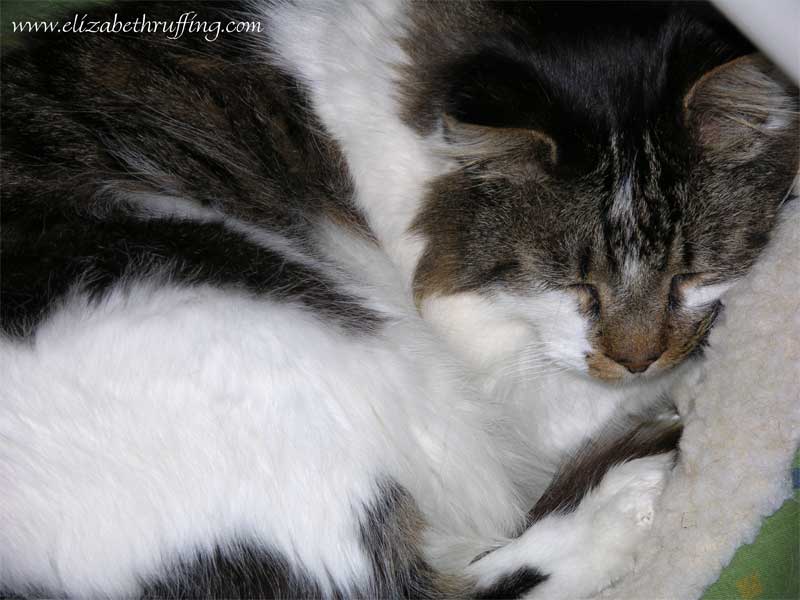 This is what my helper was doing while I was doing all of the above. Clearly, none of this is of interest to him, or he already knows how to do everything. I’ll never know.