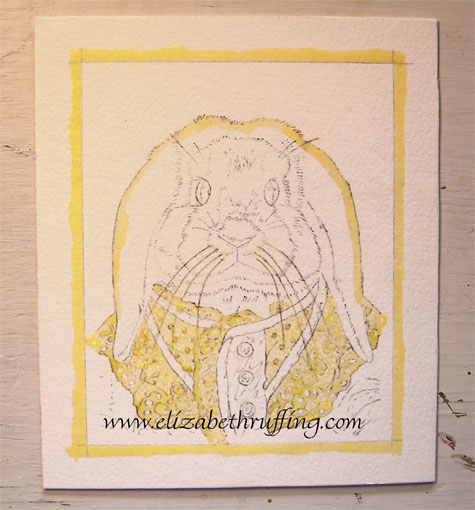
 I got my masking done on my little watercolor. Masking at its best is still like painting with thin rubber cement, and here I was trying to “paint” a lace collar with masking fluid, which was quite difficult. I can do this, I know, but I may take a departure here. The handout on the Claybord I recently bought says you can scratch the surface with a wire brush to make hairs. I might experiment and see if there is a way to scratch lace onto it. I think it might make an interesting effect, if it works.
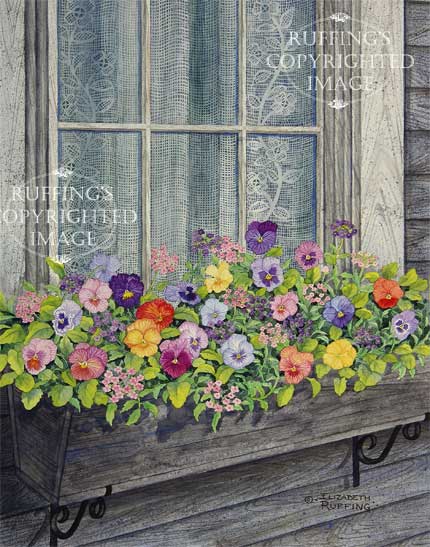 In “Window Box with Pansies“, above, I used masking fluid to paint the lace. Then I painted the watercolor over it. The masking was removed with some dried rubber cement. You can make your own eraser out of rubber cement by pouring some into a cap and letting it dry. You pry it out when it’s dry and wad it up into a ball. It works very well for removing masking fluid. You press and lift, and the masking fluid comes up with it.
Masking has its challenges aside from being somewhat “gunky” to work with. First there is the issue of your brush getting ruined. You can put plain soap on your brush (I wipe it on a bar of Ivory soap) as you paint with the masking fluid to protect your brush. Rinse your brush with water, wipe it on a paper towel, and re-soap your brush frequently before dunking it into the masking fluid. This will keep your brush hairs from getting glued together. Then there is the problem of not being able to see the masking fluid well on your paper. It used to be easier to find gray masking fluid, but now most of what you run into is yellow or white, which means you can’t be sure what you are painting as you paint. Then there is the issue of your watercolor shying away from the masking. Watercolor doesn’t always like masking fluid and doesn’t always stay right up against your masked lines. All in all, it’s a bit hit and miss.
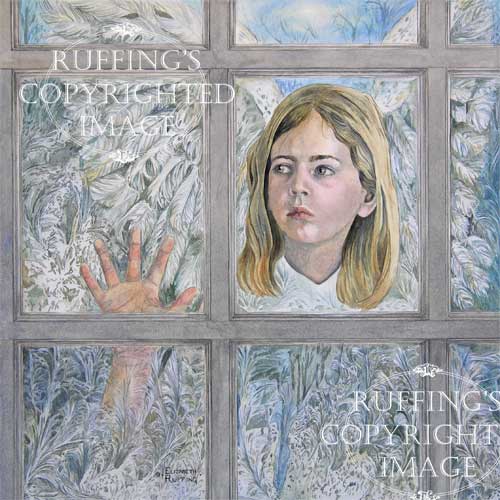 “The Frost Angel“, above, was done without masking, by working “dry brush” in sections. This means the whole background wasn’t wet to begin with. You work on dry paper. This gives you more control, but it isn’t feasible in some situations, like when you want a larger, fluid, or blended background, as you would with a sky. The masking fluid protects areas where you can’t stop to control everything. Also, working out the details and having to be conscious of where you are going in a painting like “The Frost Angel” is like being lost in a maze sometimes. You have to remember what you want to be light and dark at all times, and not mix them up.
“The Frost Angel“, above, was done without masking, by working “dry brush” in sections. This means the whole background wasn’t wet to begin with. You work on dry paper. This gives you more control, but it isn’t feasible in some situations, like when you want a larger, fluid, or blended background, as you would with a sky. The masking fluid protects areas where you can’t stop to control everything. Also, working out the details and having to be conscious of where you are going in a painting like “The Frost Angel” is like being lost in a maze sometimes. You have to remember what you want to be light and dark at all times, and not mix them up.
Watercolor purists use the white of the paper for their whites, and they avoid using opaque paint, which is, technically, referred to as gouache. I was taught to be a purist. Why this is important, I cannot tell you. I think some of us embrace the sheer difficulty of doing this. I do love a challenge, but I have also done this, and I know I can do this, already. Right now I am curious to see what else I can do, and I am thinking I want to scale this drawing up to fit my Claybord and give it a whirl. I’m interested to see if I can scratch lace into a painted area…just to see if I can.